
Written by Rachel Gerow, MA, RP. Reflections on weight loss messaging in sports, Ozempic advertising during the NHL playoffs, and the messages young people absorb through sport.
Lately, I’ve found myself reflecting on something while watching the NHL playoffs — something that actually goes as far back as the Olympics earlier this year.
It’s the increase in advertising for medications like Ozempic and other GLP-1s during major sporting events. And the more I notice it, the more it gives me pause.
Not because of the medications themselves — I want to be clear about that. These medications can be incredibly helpful and, in some cases, life-changing when used appropriately. They absolutely have a place in care.
But I keep coming back to this question: do they belong here?
There’s something about seeing weight loss messaging woven into spaces like the Olympics or playoff hockey that just doesn’t sit right. These are moments that carry a lot of meaning. They’re not just entertainment — they’re cultural touchpoints. They inspire people. They invite people into sport, into movement, into possibility.
And I can’t help but think about who’s watching.
How many young people were tuned into the Olympics this year, or are now watching the playoffs? Kids and teens who are still forming their understanding of what health looks like, what bodies “should” look like, and where they fit into all of that. Maybe they’re watching and feeling inspired. Maybe they’re thinking about joining a team, trying something new, moving their body in a different way.
And then, layered into that experience, are repeated messages about shrinking their bodies.
Even when it’s subtle, it lands. It becomes part of the backdrop. It starts to shape the narrative in ways that are easy to miss in the moment but meaningful over time.
As someone who works in eating disorder care, this is the piece that gives me the most pause. We know how powerful these messages can be. We know how quickly body dissatisfaction can take hold, especially in younger populations. And we know that sport, while incredibly beneficial in many ways, can also become a space where body image concerns are amplified when performance and appearance start to get conflated.
So when weight loss messaging shows up here, it doesn’t just exist on its own. It interacts with everything else that’s happening — the inspiration, the comparison, the vulnerability — and it can quietly reinforce the idea that being in a smaller body is part of what it means to be healthy, successful, or even worthy of participating.
And that’s just… not the message we want to be sending.
There’s also a disconnect that’s hard to ignore. The athletes we’re watching — Olympians, professional hockey players — are not there because they’ve found the most efficient way to lose weight. They’re there because of years of training, support, discipline, and skill. Reducing health or performance to body size in that context feels not only inaccurate, but dismissive of what’s actually being celebrated.
For me, this really comes down to context. Not everything that exists in healthcare needs to be part of public-facing messaging — especially not in spaces that are already so influential. Conversations about medications like GLP-1s are nuanced. They require consideration of someone’s medical history, their relationship with food and their body, and the broader psychological context they’re living in.
Those are conversations that belong in a clinician’s office — in thoughtful, individualized discussions — not something that gets absorbed in the background while watching a game or cheering on an athlete.
This isn’t about removing access or criticizing people who use these medications. It’s about being more intentional about where and how we talk about them.
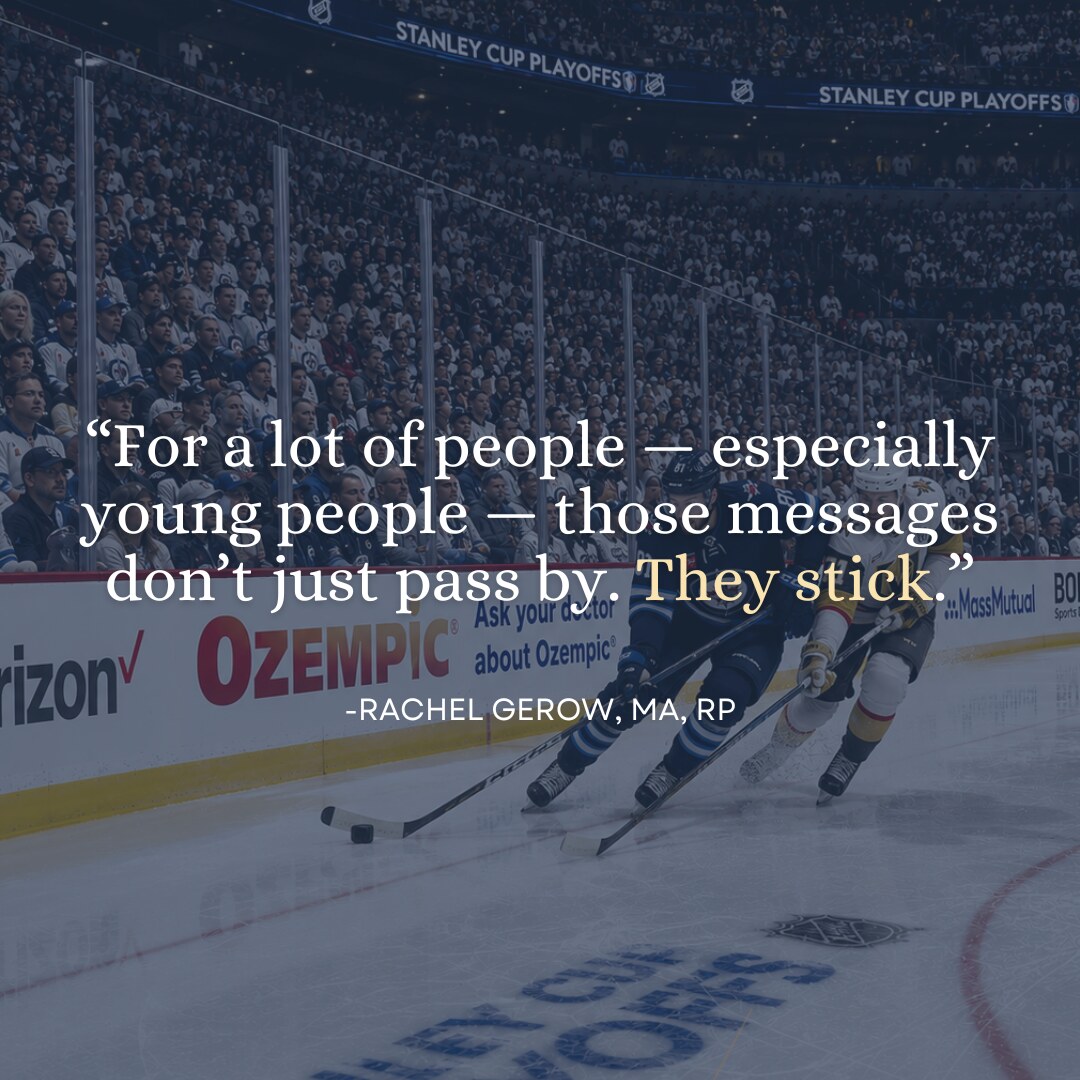
Because spaces like the Olympics and professional sports matter. The messages that show up there matter. And for a lot of people — especially young people — those messages don’t just pass by. They stick.
They shape the way people come to understand their bodies, their health, and their place in movement and sport.
And I think we owe it to them to be more thoughtful about that.