
Written by Dr. Anita Federici. Dr. Anita Federici shares reflections from her presentation on trauma-informed care in geriatrics at Waypoint Centre for Mental Health.
Last week, I had the opportunity to return to Waypoint Centre for Mental Health Care to speak with the North Simcoe Muskoka Specialized Geriatric Services (NSM SGS) team.
Waypoint holds some history for me. I worked there back in 2015, and walking back into the space brought a mix of familiarity and perspective. Some faces were new, many roles have evolved, but the core of the work felt the same: thoughtful, complex, and deeply human. There’s something grounding about reconnecting with colleagues who are doing the kind of work that doesn’t fit neatly into categories or quick solutions.
The invitation itself reflected that reality. The team supports older adults with significant complexity, often navigating frailty, cognitive impairment, medical comorbidities, and layered psychosocial needs. They are not providing psychotherapy. They are doing something arguably harder in many ways, providing care in real time, in real systems, under real constraints.
The focus of the session was trauma-informed care in geriatrics, specifically how we understand behaviour when words are limited.
When Behaviour Speaks Instead
One of the central ideas we explored, especially when it comes to trauma-informed care in geriatrics, is deceptively simple:
Behaviour is not random. It is meaningful.
In geriatric care, distress is often expressed through behaviour rather than language. Agitation, refusal, withdrawal, repetition, what we often label as “responsive behaviours” are not problems to eliminate, but signals to interpret.
On one of the early slides, we mapped this out directly:
- Aggression can function as protection from perceived threat
- Refusal can be an attempt to regain control
- Withdrawal can reduce overwhelm
- Repetition can create predictability
- Clinginess can reflect attachment and safety seeking
Once you see behaviour this way, it becomes much harder to reduce it to “non-compliance” or “difficulty.” And honestly, that’s a good thing.
Trauma-Informed Care Is Not What People Think It Is
There’s a persistent misconception that trauma-informed care is about techniques or strategies. It isn’t.
It is a stance.
As outlined in the session, trauma-informed care is a philosophical, ethical, and relational way of being, grounded in principles like safety, trust, collaboration, and choice .
And importantly, it is not the same as providing trauma treatment.
This distinction matters a lot in interdisciplinary geriatric teams. You don’t need to be doing exposure therapy to be trauma-informed. But you do need to understand how easily care can be experienced as threat.
Safety Is Not What We Think It Is
One of the moments that tends to shift thinking is this:
Safety is not just physical. It is experienced.
We can deliver technically excellent care and still create a sense of threat through how we communicate, how quickly we move, or how little control someone feels they have.
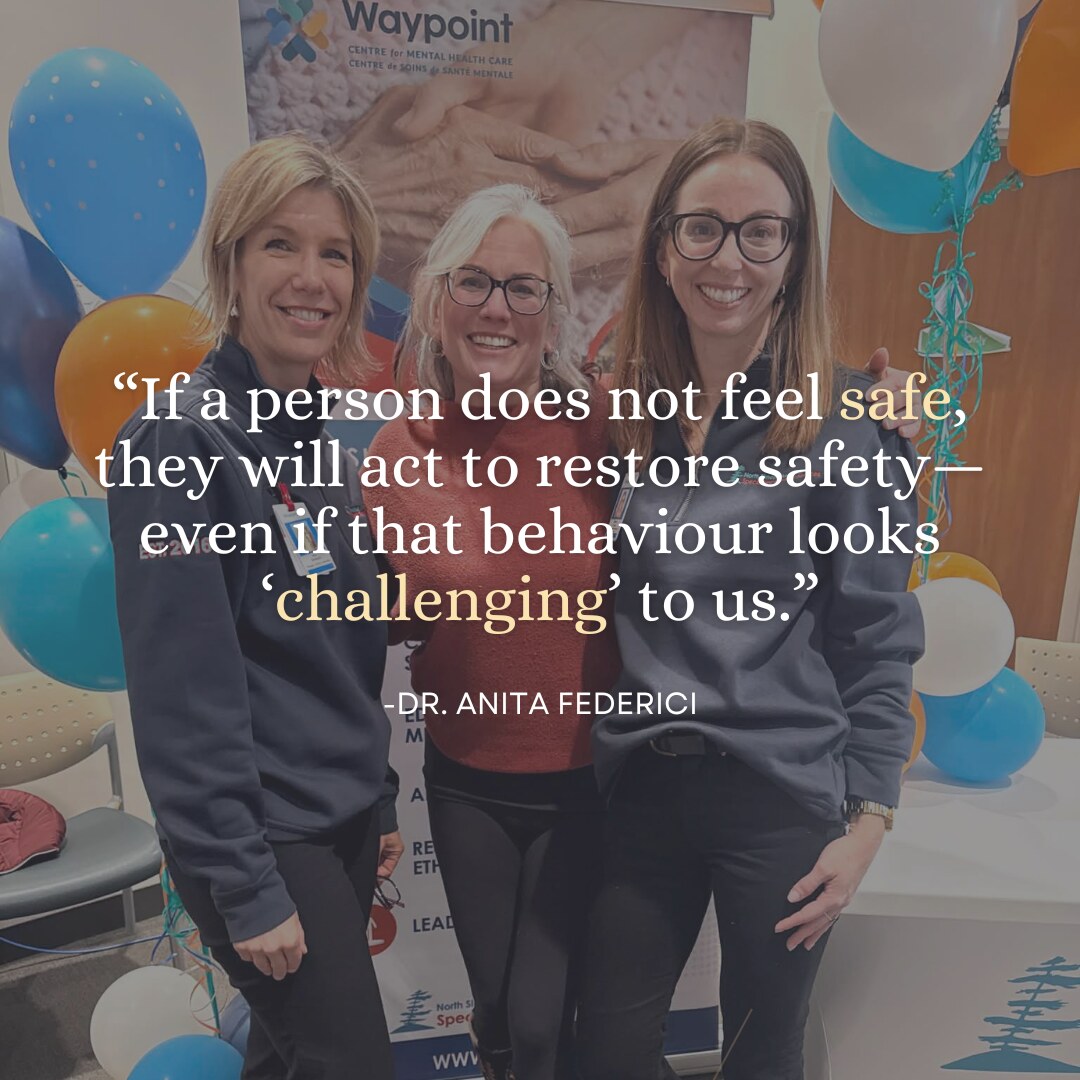
If a person does not feel safe, they will act to restore safety, even if that behaviour looks “challenging” to us .
Which means the behaviour isn’t the problem. It’s the solution, just not one that works well in the system we’re operating in.
The Work Is Dialectical (Whether We Like It or Not)
If there’s one concept that defines this work, it’s this:
We are constantly holding competing truths.
- This person has the right to refuse care and they may be at risk if they do
- This behaviour makes sense and it may be unsafe
- We want to respect autonomy and we are responsible for safety
Trauma-informed care doesn’t resolve these tensions. It requires us to tolerate and navigate them.
That’s where a dialectical stance becomes essential, moving away from “Which is right?” to “How do we hold both?” .
It’s less satisfying than a clear answer, but significantly more accurate.
What Actually Changes Practice
We spent a good portion of time translating principles into micro-level interactions, because that’s where care actually happens.
Some of the shifts are small, but not trivial:
- Narrating what you’re doing before you do it
- Offering choice, even when options are limited
- Slowing down moments of urgency
- Using collaborative language instead of directive language
- Following through on what you say you will do
These aren’t “soft skills.” They are mechanisms for building trust.
And trust, as we discussed, is built or eroded in micro-moments, through predictability, transparency, and follow-through .
Unexplained care often feels like unsafe care.
Behaviour Is Transactional (Which Means We’re In It Too)
Another piece that tends to land is the idea that behaviour doesn’t occur in isolation.
It’s transactional.
Patient behaviour influences staff response. Staff response influences patient behaviour. And very quickly, you have a reciprocal loop .
Which means escalation is often co-created, not caused by one side.
That’s not about blame. It’s about influence. We can’t control patient behaviour, but we are responsible for how we respond to it.
And that turns out to matter a lot.
The Tension Between Validation and Change
In DBT terms, we’re always balancing two tasks:
- Validation: “This makes sense”
- Change: “Something needs to shift”
Too much validation without change leads to stuckness.
Too much change without validation leads to escalation .
Geriatric care teams are navigating this balance constantly, often without naming it explicitly.
What Stayed With Me
Returning to Waypoint wasn’t just about delivering content. It was a reminder of how much nuance this work requires, and how much skill is already present in these teams.
The final slide captured it better than anything else:
You are not solving problems. You are navigating tensions.
A trauma-informed, dialectical approach allows you to hold compassion and structure at the same time.
That is the work.
Not exactly a neat conclusion. But then again, neither is the work.